A new Amazon Bedrock reference architecture demonstrates how foundation models can automate resume screening and interview preparation, aiming to shrink administrative work that slows hiring. The post opens with research showing recruiters spend an average of 17.7 hours per vacancy (survey of 748 HR leaders) and cites a 2024 SmartRecruiters finding that 45% of talent leaders spend more than half their time on tasks that can be automated. The architecture is presented as an instructional example, not a turnkey production system.
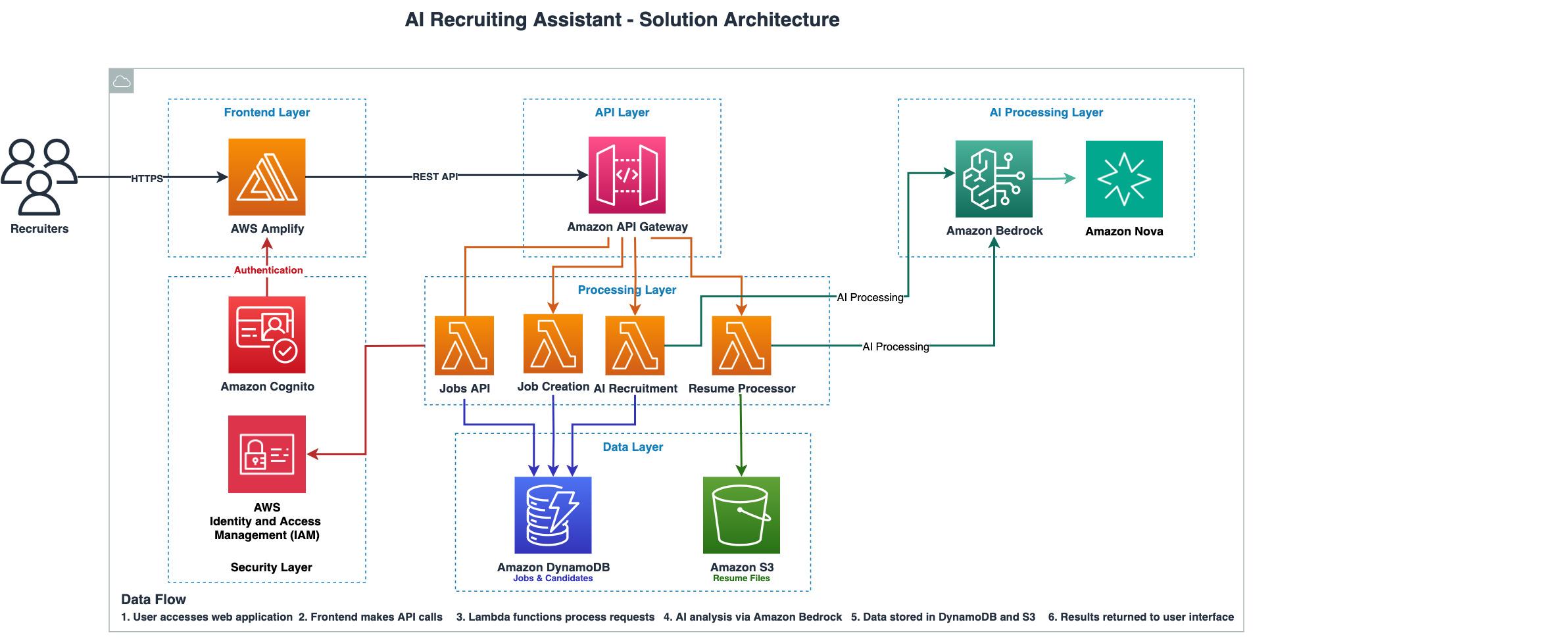
The design coordinates Bedrock models through the Bedrock Converse API (demonstrated using Amazon Nova Pro) and pairs them with serverless AWS building blocks. Core components include AWS Lambda for compute, Amazon API Gateway for routing, Amazon DynamoDB and Amazon S3 for storage, AWS Amplify to host the frontend, Amazon Cognito for authentication and JWT issuance, and IAM roles to enforce least‑privilege access across components.
Model safety and responsible output handling are integrated into the pipeline via Amazon Bedrock Guardrails. The guardrails provide PII anonymization, detect prompt‑injection style attacks, and filter bias‑related content before results are delivered to recruiters. The post frames these controls as active parts of processing — invoked alongside FM calls — rather than optional add‑ons, to reduce the risk of unsafe or biased generative reasoning.
From an operations and implementation standpoint, the guide gives concrete configuration advice that matters in practice. API Gateway is shown using a Cognito authorizer to validate JWTs on every request; specialized Lambda functions are recommended to handle distinct recruitment workflows; and architects are told to configure appropriate timeout and memory settings per function. The post repeatedly stresses that security controls and IAM configuration remain the customer’s responsibility and must be tailored to organizational requirements.
The example application flow is explicit: a React frontend hosted via Amplify lets recruiters upload resumes, Cognito authenticates users, API Gateway routes requests to Lambda handlers, and those handlers call the Bedrock Converse API to perform deep resume analysis. The FM outputs feed multi‑dimensional compatibility scores, generate role‑specific interview questions, and produce structured skill assessments, with DynamoDB and S3 used for persisting candidate profiles and artifacts.
While the referenced services are presented as general‑purpose tools customers can combine for many recruiting scenarios, the post cautions teams to adapt the pattern before moving toward production. It highlights the need to tune model prompts and guardrail policies, define storage retention practices, and harden security posture to meet each organization’s compliance, fairness, and operational SLA requirements.
Sources
Replies (0)
No replies in this topic yet.
