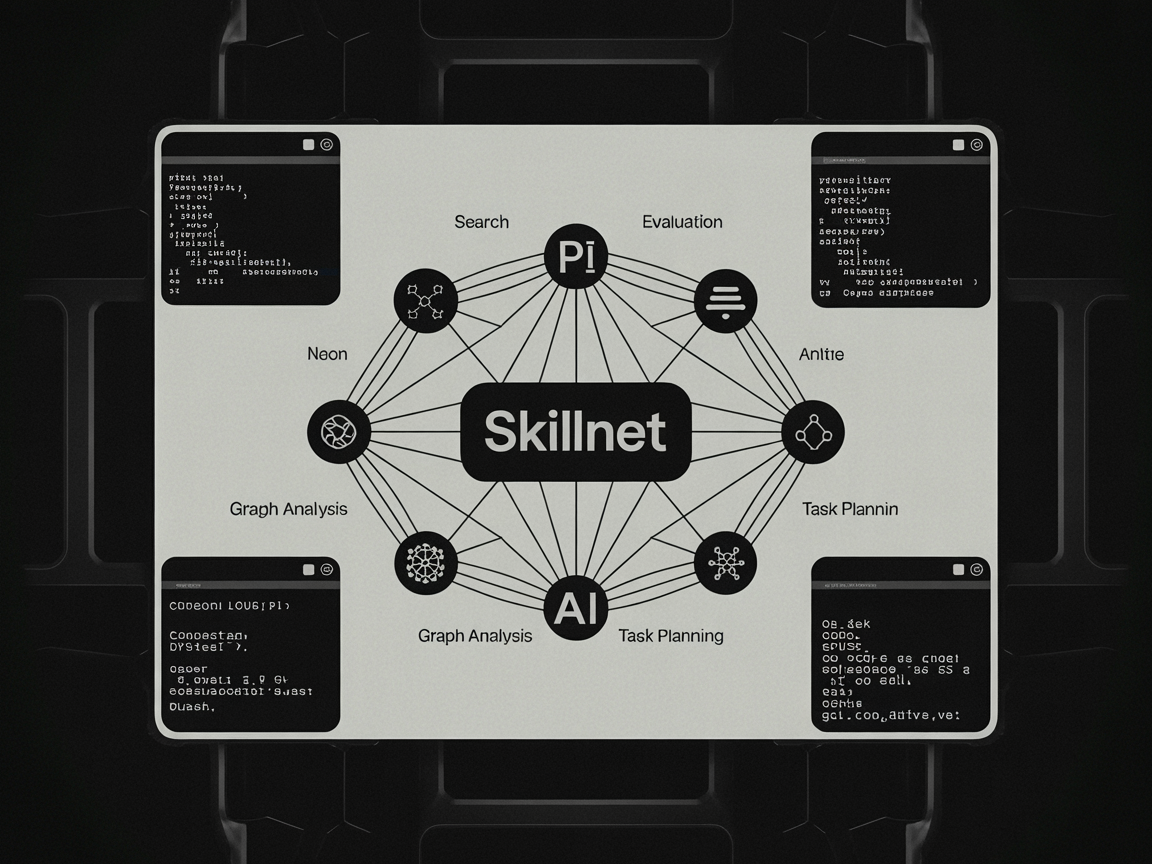
A hands‑on tutorial demonstrates how to use SkillNet to discover, install, inspect, evaluate and organize reusable AI skills, then assemble them into a skill‑augmented agent planner that decomposes complex goals into subtasks and builds execution pipelines. The walkthrough opens with environment setup and client initialization and proceeds through search, evaluation, graph analysis and task planning to illustrate an end‑to‑end pattern for composing modular AI agents. That pattern offers developers a reproducible method for composing tested skill chains and orchestration logic.
The guide installs required dependencies — skillnet‑ai, networkx, matplotlib and requests — and configures API keys and environment variables, including BASE_URL (default https://api.openai.com/v1), SKILLNET_MODEL (default gpt-4o), GITHUB_TOKEN and GITHUB_MIRROR. It creates a working directory (./skillnet_demo) and a skills folder, defines helper utilities such as a banner function, and demonstrates attempting to load skillnet_ai.SkillNetClient with a REST fallback when the SDK is unavailable.
Hands‑on steps compare keyword search with semantic search to locate skills for different task requirements, install curated skills from GitHub, inspect skill metadata, and apply a quality gate across key evaluation dimensions. The tutorial also shows how to visualize relationships between skills as a graph using networkx and matplotlib, and how REST endpoints (example REST_BASE = http://api-skillnet.openkg.cn/v1) are used for search and download when SDK access fails.
Finally, the tutorial builds a skill‑augmented agent planner that decomposes a complex goal into subtasks, discovers and filters relevant skills, and assembles an execution pipeline linking selected components. The emphasis is on reusable, evaluated skill libraries and a reproducible developer workflow for composing tested skill chains and orchestration logic when constructing modular AI agents.
Sources
Replies (0)
No replies in this topic yet.
