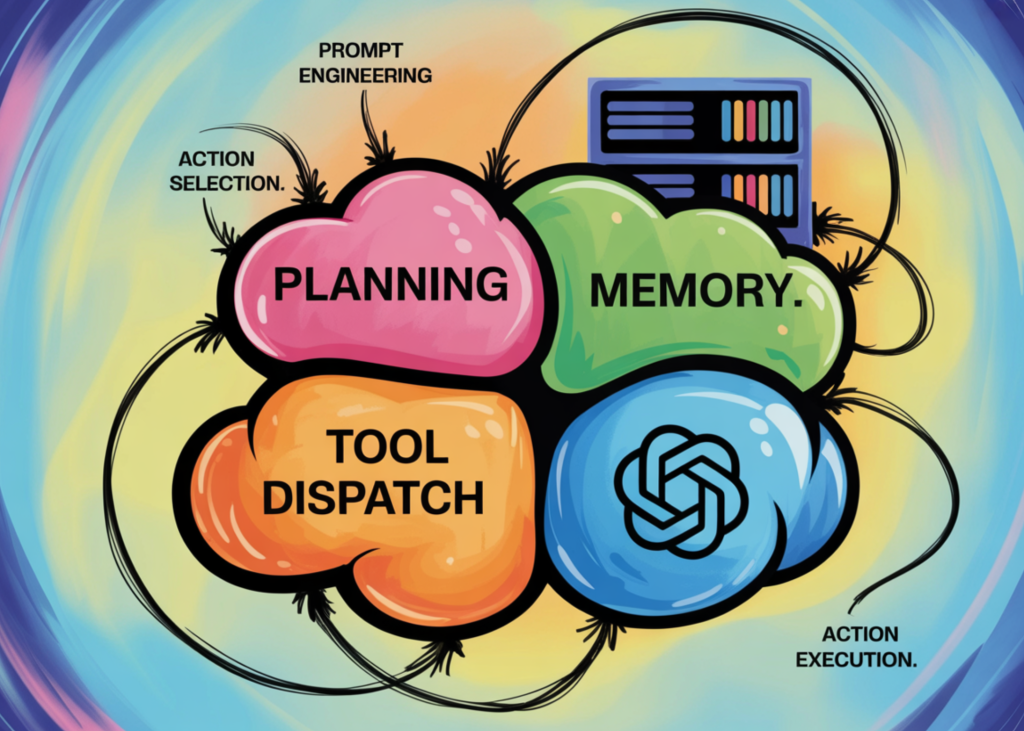
A developer tutorial published May 12, 2026 provides runnable Python code and architecture guidance for autonomous agents that combine semantic vector search and keyword — based BM25 retrieval with a modular tool-dispatch loop.
A developer tutorial published May 12, 2026 demonstrates how to assemble an autonomous agent using OpenAI models and a hybrid memory architecture, offering runnable Python code and design guidance for agents that reason, remember and act. The guide is intended for teams building agents that require long-term memory and external tool calls, and explains why combining multiple retrieval methods and a pluggable tool loop matters for robustness and extensibility.
The examples are Python — first and start with pip install openai numpy rank_bm25 and secure API key entry via getpass. The code sets EMBED_MODEL to "text-embedding-3-small" and CHAT_MODEL to "gpt-4o-mini", instantiates an OpenAI client, and shows classes such as MemoryBackend, LLMProvider and Tool. Sample types include a MemoryChunk dataclass, an _embed helper that normalizes vectors, and explicit use of BM25Okapi with an RRF_K = 60 parameter appearing in retrieval examples.
Architecturally, the tutorial avoids a single retrieval strategy by combining semantic vector search with keyword — based BM25 retrieval and a modular tool-dispatching loop. It separates concerns through abstract memory and LLM provider interfaces and pluggable tools so teams can swap memory backends, change embedding or chat models, or extend tool behavior without rewriting core control logic.
For developers the guide functions as a practical blueprint for prototyping agents that maintain and query long-term memory and invoke external tools. It highlights implementation details — embedding normalization, tokenization, BM25 integration — and operational practices such as secure key handling and explicit model constants, making the code usable for experimentation and further customization with OpenAI APIs.
Sources
Replies (0)
No replies in this topic yet.
