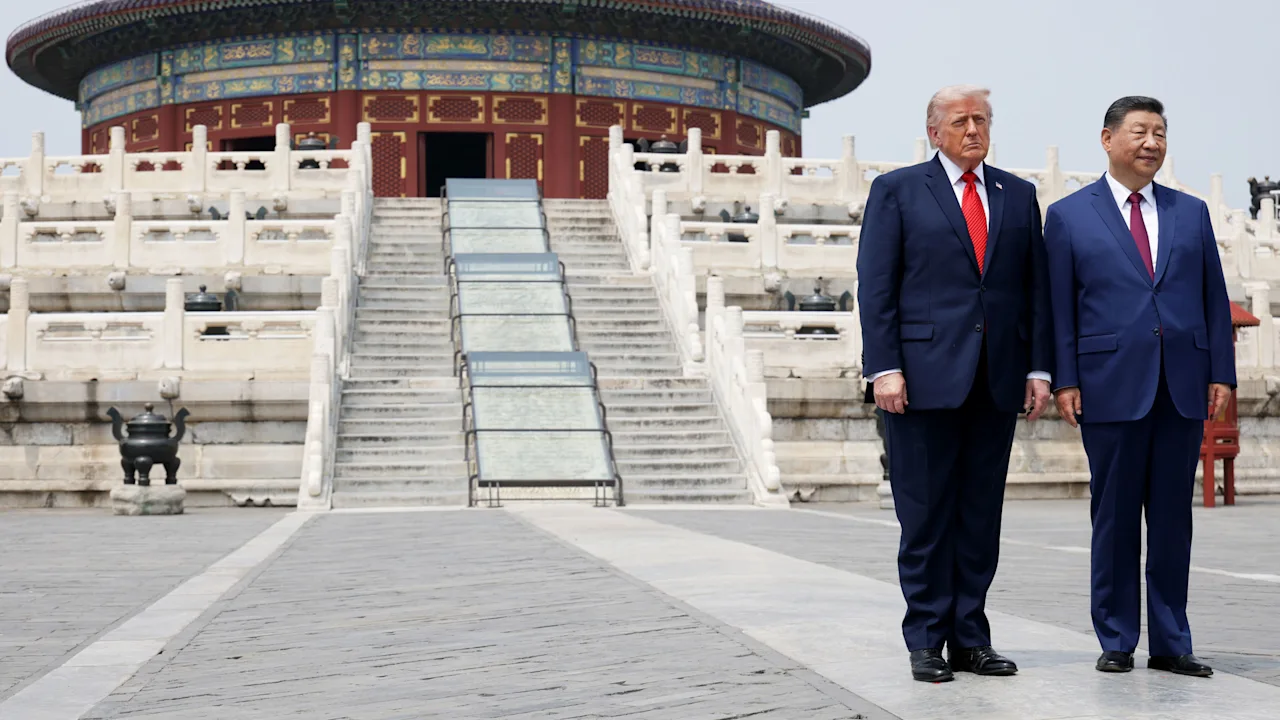
U.S. President Donald Trump and Chinese President Xi Jinping met in Beijing this week, and U.S. officials publicly signaled plans to open discussions about a dedicated government — to-government communication channel focused on artificial intelligence. The proposal is pitched as a practical step to prevent misunderstandings or unintended escalations as both governments and private firms accelerate development of advanced AI systems amid deep mutual distrust.
Washington has already tightened export controls on technologies and equipment to slow China’s AI progress, but U.S. sources tell reporters that restricting chip exports alone will not halt Beijing’s advances. Officials framed the proposed channel as a complementary tool to export policy: a mechanism for rapid exchanges about AI capabilities, deployment choices, and potential safety concerns so that technical developments do not become inadvertent triggers for confrontation.
On the commercial front, Chinese AI models such as DeepSeek are competing globally against American products, and the White House has accused Beijing of running industrial — scale operations aimed at extracting and copying U.S. AI models. Those allegations underscore the intellectual — property and market — competition dimensions of the rivalry, where commercial incentives and national strategy are increasingly entangled.
Security agencies on both sides have reportedly explored AI as a component of offensive cyber tactics, and the reporting notes experiments that use AI tools in cyber operations. That parallel development of potentially hostile capabilities creates a classic security dilemma: each side’s efforts to gain an edge raise the other’s incentives to escalate, increasing the risk of miscalculation unless communication or confidence — building measures are put in place.
Domestic dynamics in the United States complicate any bilateral framework. American AI companies remain at odds with U.S. regulators, which the piece says have not yet produced clear guidelines for releasing new models; talks within the U.S. government on regulation have been ongoing for months, while many firms have long opposed stricter government controls. That unresolved domestic policy environment, combined with strategic rivalry and commercial competition, makes international coordination both important and difficult.
The author argues the situation is unprecedented after decades in the tech industry: accelerating AI capabilities, contested commercial practices, and unclear regulatory guardrails all increase systemic risk. For builders and policymakers, the practical implication is familiar but urgent — technical safeguards, reliable cross — border communication channels, and clearer domestic policy are needed to reduce risks to global cybersecurity networks and to lower the chance that AI developments become inadvertent sources of bilateral conflict.
Sources
Replies (0)
No replies in this topic yet.
