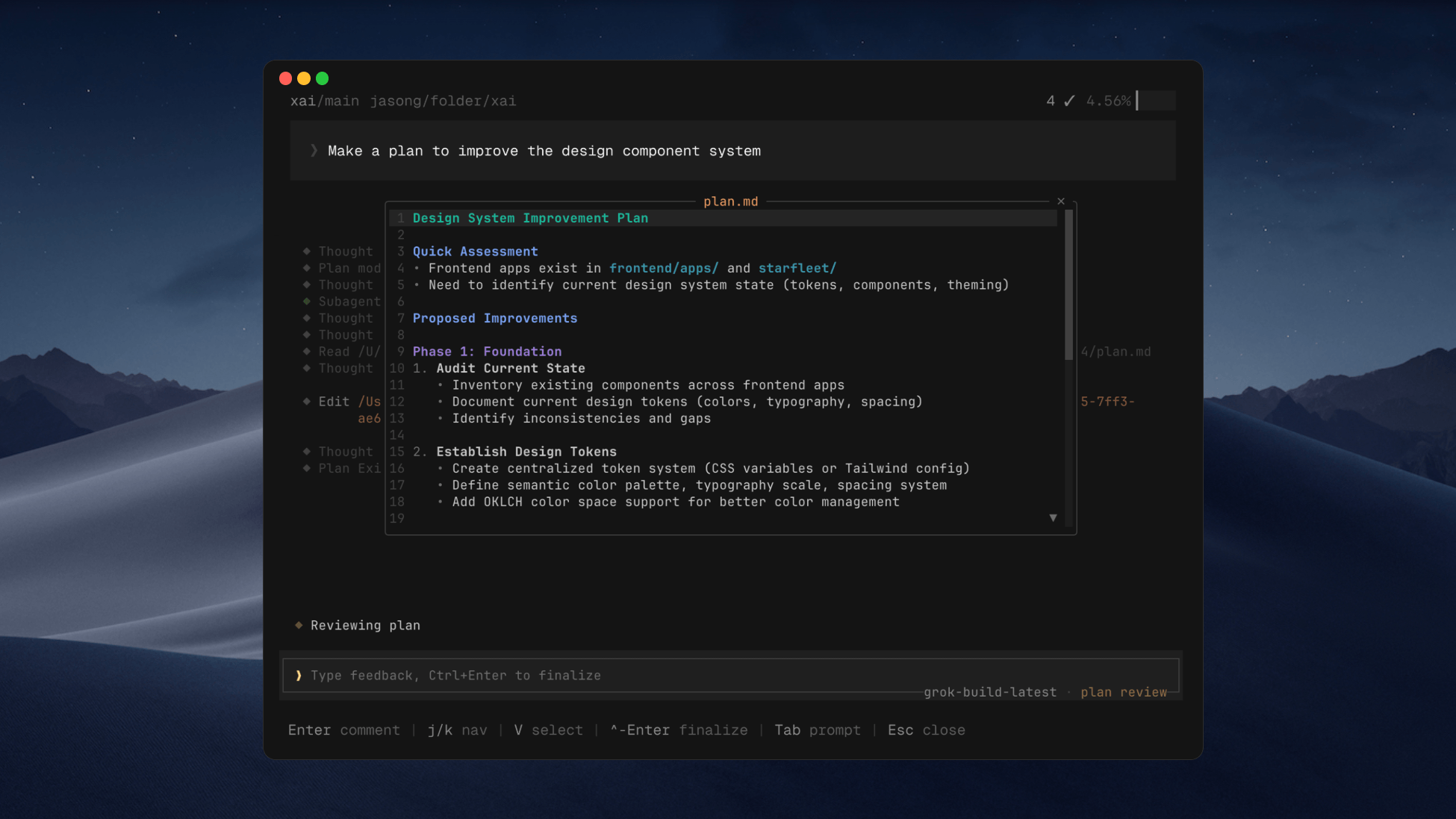
X.AI unveiled Grok Build on May 15, 2026, a terminal — first coding agent released in an early beta that aims to automate code changes and engineering tasks directly from the command line. The launch positions x.AI in the developer — facing coding agent market and centers on auditability and automation: the agent provides a plan mode that requires step-by-step approval, produces diffs before applying changes, can spawn parallel sub-agents to break up large jobs, and includes a headless '-p' flag for noninteractive scripting and pipeline use.
If access broadens, these features could make agent — driven edits simpler to fold into existing developer workflows. Grok Build runs as a CLI and supports both interactive and scripted flows, accepting configurations and integrations familiar to developers. x.AI has built feedback collection into the tool via an in-app '/feedback' command. The agent is designed to work with teams’ existing setups, carrying over established configuration styles and supporting plugins and hooks to ease adoption.
The release follows similar moves by competitors and echoes prior work in the space: observers note it arrives after offerings such as Anthropic’s Claude Code and earlier OpenAI projects around Codex, and that Grok Build mirrors many core capabilities of those tools. Analysts characterize the product as aligning with current coding — agent patterns rather than introducing new primitives, making it a feature — complete but later entry from x.AI.
For engineering teams, Grok Build’s CLI orientation and diffs — before-change model emphasize developer control and audit trails: explicit plan approvals and automatic diffs aim to reduce unexpected edits, while parallel sub-agents can accelerate complex, multi — step tasks. The headless '-p' mode is explicitly aimed at CI/CD and scripted automation so teams can incorporate the agent into build and test pipelines where permitted.
Practical integration choices also aim to lower friction: the agent supports AGENTS.md-style configurations, plugins, hooks and can interact with MCP servers that teams already use, enabling a path from local terminals to automated build systems. The main constraint is availability — Grok Build’s early beta is limited to SuperGrok Heavy subscribers, which will restrict uptake by open-source projects and smaller teams until a broader rollout. x.AI’s CLI-first design and in-tool feedback channel point to iterative improvements, but wider adoption will hinge on pricing, access, and how quickly the company expands availability beyond the subscriber tier.
Sources
Replies (0)
No replies in this topic yet.
