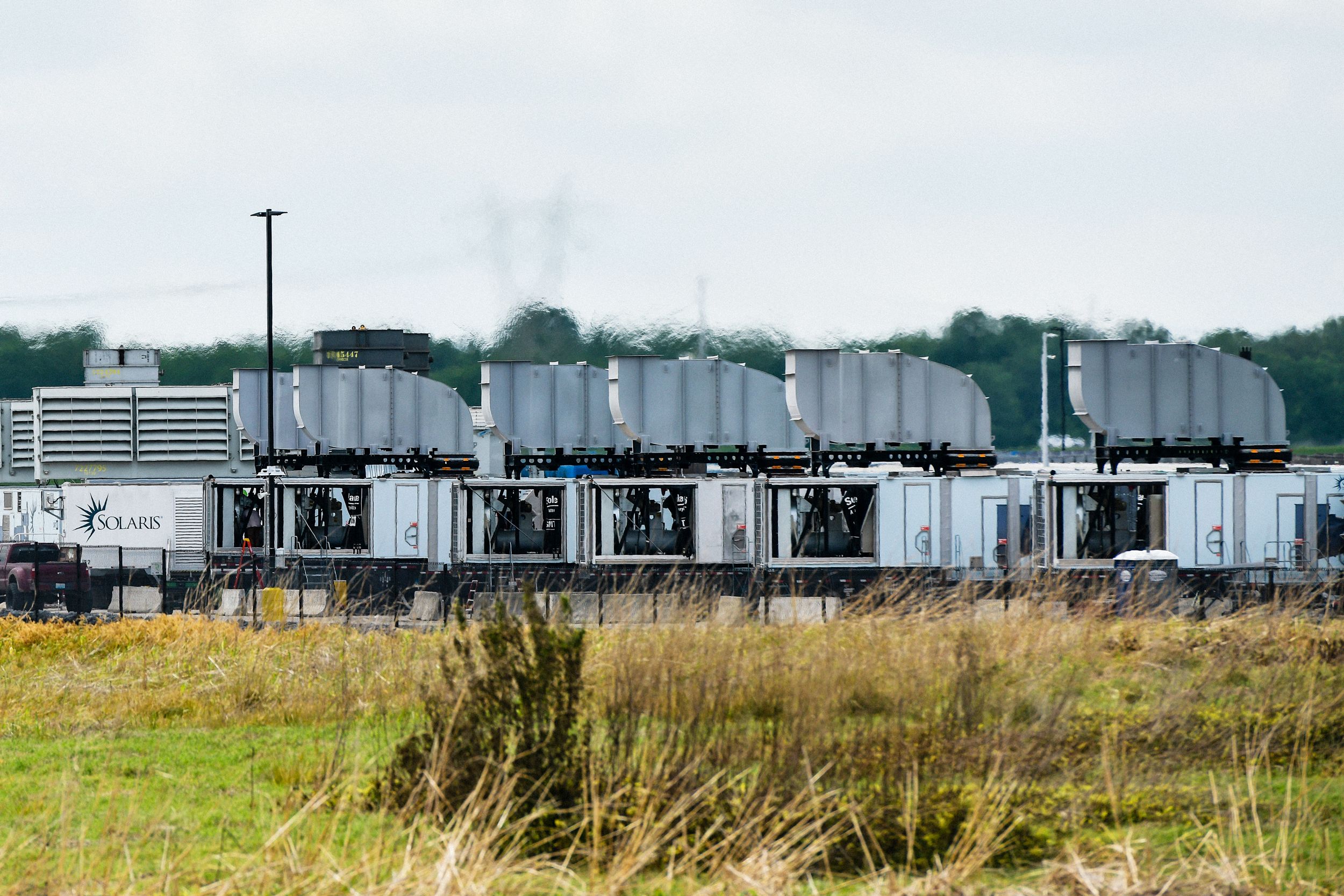
XAI installed 19 portable natural‑gas turbines at its Colossus 2 data center in Southaven, Mississippi, between late March and early May, internal emails reviewed by reporters show. The additions raise the number of turbines operating or staged on site to 46 and, according to a spreadsheet included with the correspondence, amount to more than 500 megawatts of added capacity since mid‑March. This buildup is significant because it occurred while the company faces litigation over whether some units are operating without required permits.
The records indicate that eight of the 19 new units — together representing more than 200 megawatts — were put in place after a lawsuit was filed in April. The spreadsheet attached to the emails lists a “Total Power Output” for each unit, allowing reviewers to piece together the rapid escalation in onsite generation capacity in recent weeks.
In April the NAACP, the Southern Environmental Law Center (SELC) and Earthjustice sued xAI, alleging the company ran 27 turbines at Colossus 2 without the air permits required under the Clean Air Act for stationary sources. Federal rules, however, treat these devices as portable and allow them to operate for up to a year before they must be classified as stationary units subject to full permitting, a regulatory distinction that figures prominently in the dispute.
Legal filings from the NAACP emphasize the local air‑quality and climate implications of large‑scale gas burning: the organization says the original 27 turbines represent roughly 495 megawatts of generating capacity, a level the filing equates to powering about 400,000 homes. The groups describe the cluster of onsite generators as a concentrated “personal power plant” and have sought emergency relief in court; last week the NAACP filed for an emergency injunction asking the courts to shut down the turbines.
State regulators have taken mixed steps. Mississippi’s Department of Environmental Quality granted an air permit in March allowing 41 turbines at the Southaven site, and a department spokesperson said portable units are equipped with emission controls while officials evaluate when additional temporary turbines can no longer be added. SELC obtained MDEQ emails through a public‑records request; separate drone footage and reporting show multiple turbines were operating in the weeks before the March permit was issued.
Both Colossus data centers are connected to local power grids but are also designed to rely heavily on onsite gas generation. Community groups and local officials raised similar concerns when Colossus 1 in Memphis faced permit and air‑quality fights in 2024, and opponents say the pattern at Colossus 2 repeats those localized public‑health and regulatory tensions.
Sources
Replies (0)
No replies in this topic yet.
