Researchers at Yonsei University, led by Ki Jun Yu, have demonstrated a wearable system of seven wireless, flexible rings that transmits finger motion to an AI model and translates 200 sign‑language words into text with about 88% accuracy on users excluded from training. The experiment translated 100 common American Sign Language words with 88.3% accuracy and 100 International Sign words with 88.5% accuracy, outcomes the team says mark an important step toward practical, lightweight sign‑language translation systems for real‑world use.
The hardware replaces bulky gloves and camera setups with seven small rings, each built on a flexible substrate containing accelerometers and an on‑chip Bluetooth Low Energy system‑on‑chip (SoC). Rings detect both static postures and dynamic movements and can be positioned to fit different hand sizes, sending inertial data wirelessly to a processor so users are not tethered by wires or limited by fixed cameras. To improve mechanical longevity, the designers substituted straight copper interconnects that fatigued under flexing with serpentine patterned interconnects that better withstand repeated bending.
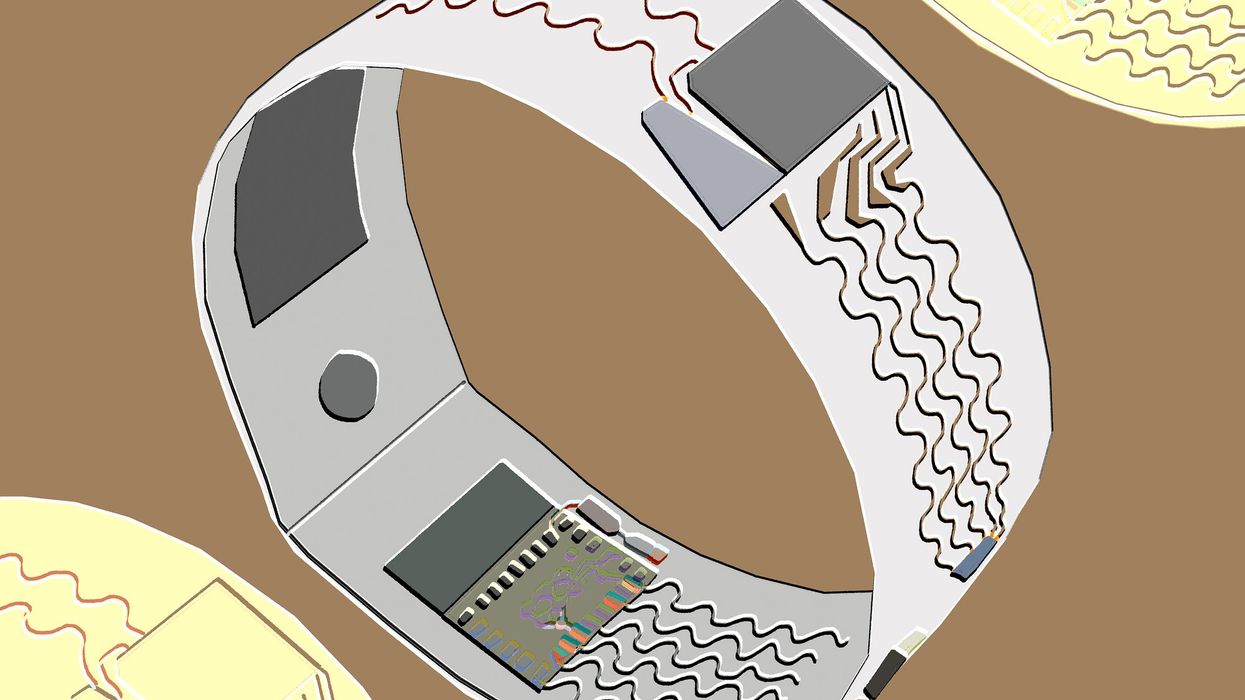
On the software side, the team trained a deep‑learning recognizer and explicitly tested generalization across people: the model was trained on gestures from two participants and evaluated on five different people who did not take part in training. That cross‑user testing produced the reported accuracies and underpins the team’s claim that inertial sensing can reduce the need for per‑user calibration. The researchers deliberately avoided bioelectric signals such as surface EMG, noting those signals tend to be highly personalized and typically require per‑user calibration, which complicates out‑of‑the‑box use.
The seven‑ring approach addresses several limitations of prior methods. Camera‑based systems can be disrupted by lighting and require fixed setups, while smart gloves often trap heat, fix sensor placement, and rely on wires or a single transmitter. By cutting hardware complexity, allowing unrestricted hand motion and flexible sensor placement, the rings aim to better accommodate individual anatomical variation without the thermal and wiring drawbacks of gloves or the environmental sensitivities of vision systems.
Despite these gains, the researchers and outside commenters stress that 200 recognized words remain a small fraction of full sign‑language vocabularies, which can include thousands of signs, and that open‑vocabulary, real‑world conversations remain out of reach. The results indicate promising cross‑user generalization, but wider signer populations, larger vocabularies, longer‑term durability testing and further lexicon scaling will be needed before such ring systems can be deployed for everyday communication.
Sources
Replies (0)
No replies in this topic yet.
