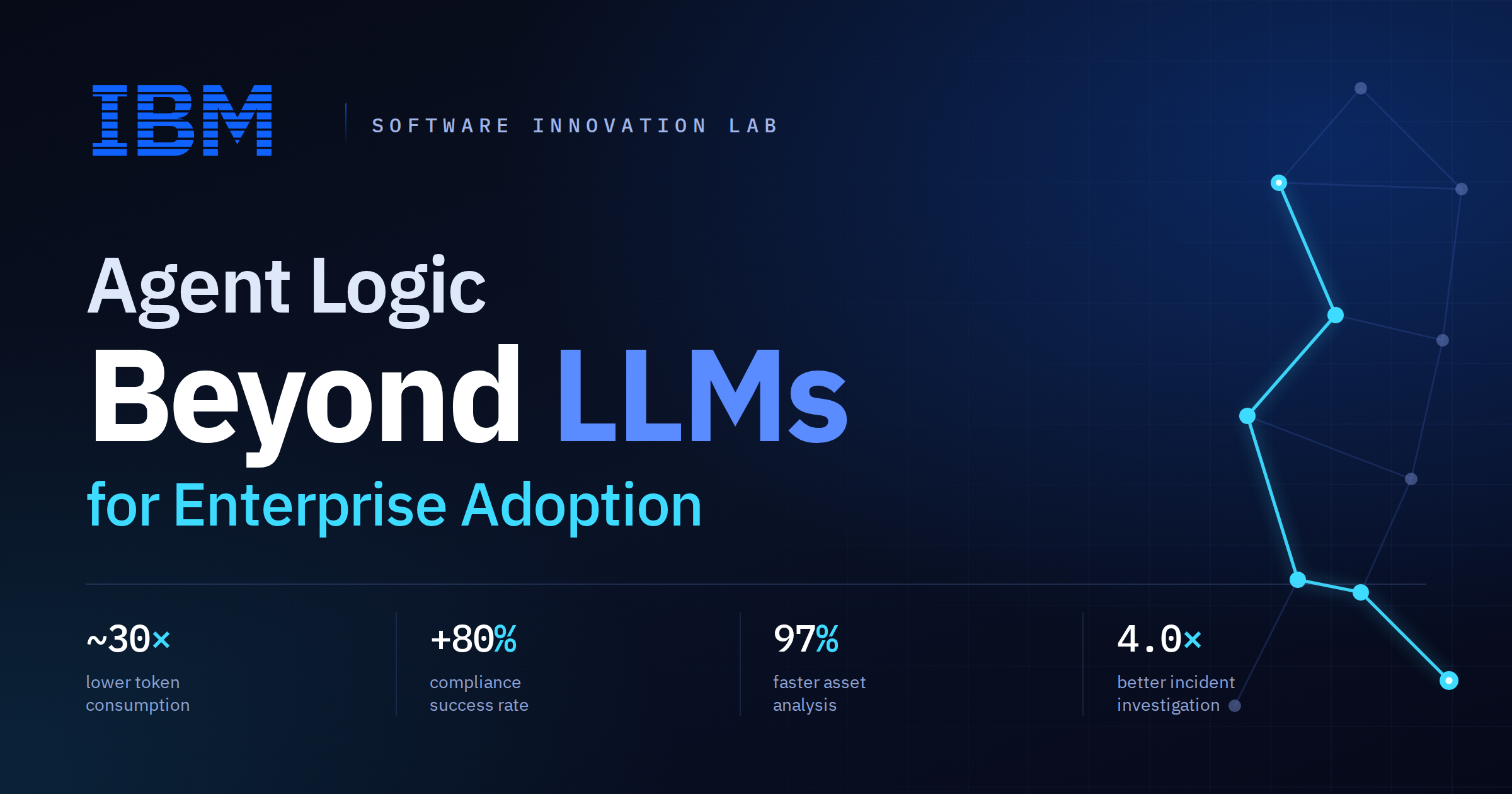
IBM Research says explicit agent logic is required to make agentic AI practical at enterprise scale, arguing in a June 1, 2026 post by Nicholas Fuller that structured primitives are needed to run large language models reliably inside dynamic, long‑running workflows. The paper’s central claim is that high agent quality, predictable costs and end‑user trust hinge on intentionally steering LLMs with designed software components rather than relying on LLMs alone. This matters because enterprises routinely operate across many services, APIs and regulated processes where naive LLM use becomes impractical or costly.
To demonstrate the point, IBM designed and deployed agents inside multiple IBM offerings, most concretely in IBM watsonx Code Assistant for Z (WCA4Z). WCA4Z’s App Insights agent performs deep static analysis of mission‑critical mainframe applications, producing a pre‑indexed representation stored in a relational schema that spans hundreds of interrelated tables. That structured retrieval layer is used to narrow model context, improve answer accuracy and reduce token consumption during run time.
IBM evaluated the App Insights agent on large legacy systems — up to roughly 1 million lines of code and about 1,000 programs — and reports that the agent maintained marginally superior application‑understanding performance while cutting token use by roughly 30× compared with a baseline “LLM‑only” approach. The post cites Mistral Medium 250B as the frontier LLM used in the example benchmarking. IBM frames these results around enterprise workflow realities: workflows are long‑running, change over time, span many data sources, and are often bound by business policies or regulations.
The post defines “agent logic” as a collection of software primitives — knowledge graphs, algorithms, program‑analysis libraries and similar components — that run in an agent harness to intentionally steer the LLM. Those primitives narrow the relevant context space and route the model toward more performant, cost‑effective outputs, reducing unnecessary model interactions and limiting exposure to hallucinations tied to expanded context windows. IBM notes the approach applies beyond legacy code analysis to other enterprise domains, including test generation, incident response and compliance modernization. The argument is that the same pattern — combining structured analysis, pre‑indexed retrieval and targeted algorithmic controls — can improve reliability and lower operational costs wherever workflows are regulated, complex or long‑lived.
For practitioners, the takeaway is clear: when targeting mission‑critical, long‑running enterprise workflows, combine structured program analysis and pre‑indexed retrieval with LLMs rather than relying on LLMs alone. According to IBM, that combination delivers lower token consumption, fewer back‑and‑forth interactions with models, and more reliable outputs suited to regulated or complex enterprise uses.
Sources
Replies (0)
No replies in this topic yet.
