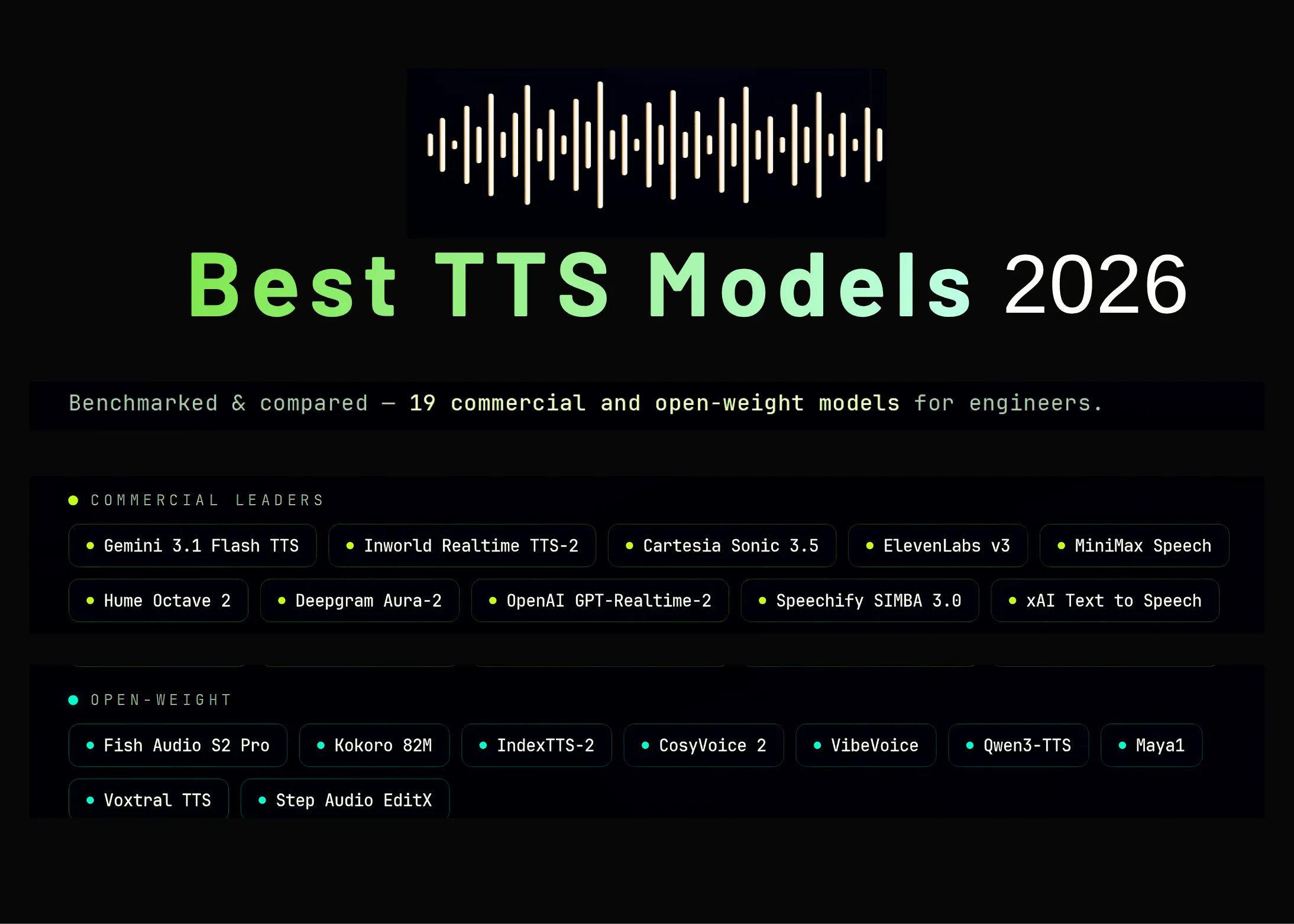
A May 30, 2026 benchmark roundup finds low-latency, highly expressive TTS models — and trade — offs in latency, control, language coverage and price — now dictate production decisions for real-time and large — scale voice applications.
A May 30, 2026 benchmark roundup shows that low-latency, expressive text-to-speech (TTS) models — led by offerings from Inworld AI and Google DeepMind’s Gemini 3.1 Flash — are reshaping which systems engineers pick for production. The guide highlights measurable shifts over the past year: perceived quality has closed toward human speech, some systems now report latency below 100 ms, and emotional or style controls have moved from demo features to standard capabilities. That matters for builders of real-time applications, where sub-100 ms responsiveness and fine-grained expressive steering can be deciding factors.
Two public leaderboards are central to the community conversation. The Artificial Analysis Speech Arena ranks dozens of production APIs by blind human preference using an ELO-style system, while the community — run TTS Arena on Hugging Face applies blind A/B voting. As of May 30, 2026 the Artificial Analysis leaderboard listed Gemini 3.1 Flash TTS, Realtime TTS-2 (Research Preview), Sonic 3.5, Realtime TTS 1.5 Max, and Fun — Realtime-TTS-Preview in its top five; the guide emphasizes these placements are point — in-time snapshots and shift frequently.
The roundup separates perceived quality from accuracy and latency and recommends concrete metrics. Trelis Research evaluated ten models with a round — trip character error rate (CER) — transcribing generated audio with an ASR model and comparing it to the input text-and paired that with mean opinion score (MOS) for naturalness, while noting limits: round — trip CER depends on the ASR’s accuracy and the UTMOS estimator was trained only on clips up to ten seconds. Latency was framed as time-to-first-audio (TTFA) rather than time-to-first-byte (TTFB), and a Gradium benchmark called out interquartile ranges and tail latency as critical for user experience.
Inworld AI’s releases are singled out for production readiness. TTS-1.5, released January 21, 2026, and Realtime TTS-2 are noted for expanded expressiveness and stability: Inworld reports roughly 30% more expressive range over TTS-1 and about 40% better stability measured by word error rate and output consistency. TTS-1.5 ships in Mini (latency — optimized) and Max (stability — optimized) tiers with P90 TTFA under ~130 ms for Mini and under ~250 ms for Max, supporting 15 languages; Realtime TTS-2 covers over 100 languages and emphasizes closed — loop steering.
On — Demand and Creator list $25 per million characters for TTS-1.5 Mini and $35 for Realtime TTS-2 and TTS-1.5 Max; Developer and Growth plans reduce those to $15 for Mini and $25 for Max/TTS-2; Enterprise rates can fall as low as $5 and $10. The company reported occupying three of the top five slots on the Artificial Analysis leaderboard in recent snapshots.
Sources
Replies (0)
No replies in this topic yet.
