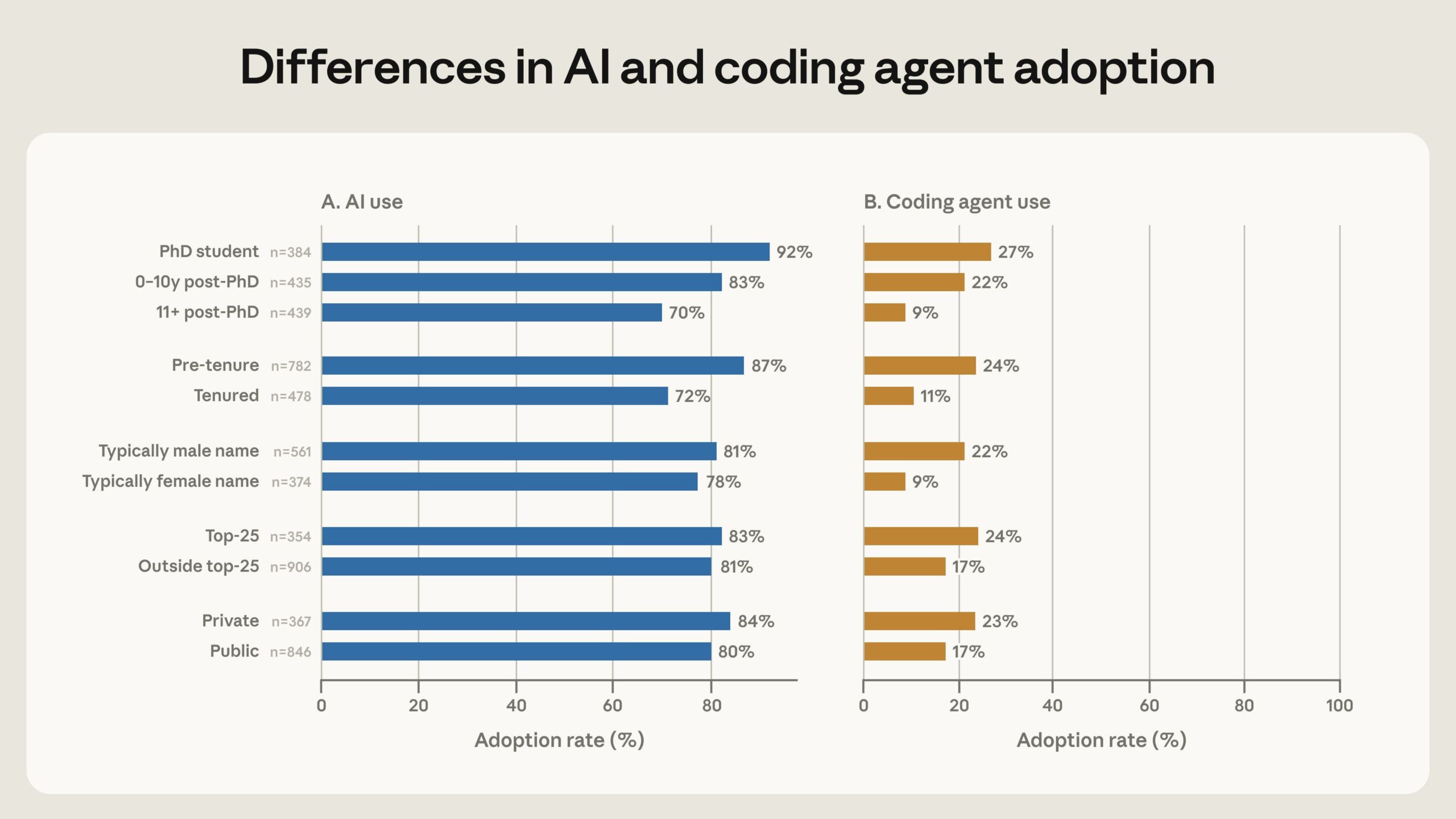
A survey and analysis by Anthropic found that social scientists with typically male names report using AI coding agents more than twice as often as those with typically female names, a disparity that holds even when comparing researchers within the same discipline and career stage. That gap matters because uneven adoption of code-generating tools can shape who benefits from productivity gains and may widen existing inequities in research output.
Anthropic defines coding agents as AI tools that automatically write program code (for example, Claude Code). Among respondents who use coding agents, 97% cited code generation for data analysis as the dominant application. Using AI to draft text was less common overall: 54% of coding — agent users reported using AI to draft text, compared with 30% of other AI users. Economists were the most likely discipline to use AI for both code generation and writing, with about half of economists using these tools for drafting as well as analysis.
Adoption differs sharply by field and institution. Economists reported the highest coding — agent usage at 39%, while education researchers reported the lowest at 4%. Early — career researchers — PhD students and postdocs — use coding AI far more frequently than professors. Respondents at top-25 universities reported using coding agents about 40% more often than peers at other institutions.
Respondents were broadly optimistic about personal gains from AI: 88% rated AI’s effect on their own paper output above 5 on a 10 — point scale, and roughly half rated it 8 or higher. Coding — agent users were particularly upbeat. At the same time, about 70% of respondents were more positive about their own productivity gains than they were about AI’s impact on the social sciences as a whole.
The authors flag potential risks tied to higher output and uneven adoption. They warn that increased productivity could overload peer review, intensify competition, and exacerbate selective reporting and incremental research. The paper links these risks to trends observed elsewhere, including a noted rise in AI-related citation fabrication in biomedical research since 2023.
Sources
Replies (0)
No replies in this topic yet.
