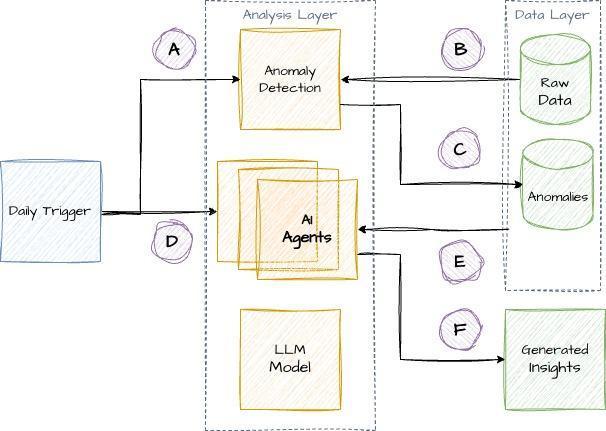
Verizon Connect has deployed an agentic AI pipeline that turns massive fleet telemetry into targeted, human‑readable insights for 100,000 daily users of its Reveal platform, addressing an operational bottleneck where manual anomaly hunting was no longer feasible. The system ingests telemetry from 1.2 million active vehicle subscriptions that generate more than 500 million data points per day across roughly 80,000 unique indicators, and produces prioritized findings that fleet managers can act on quickly.
The workflow is staged and automated: a daily trigger launches the pipeline, an anomaly‑detection module consumes structured data from the raw store and writes identified anomalies to a dedicated anomalies table, multiple AI agents run in parallel to investigate those anomalies, and agents synthesize their findings into generated insights that are returned to Reveal for delivery. Persisting anomalies enables targeted, efficient agent queries rather than broad scans of raw telemetry.
To keep numeric analysis accurate and scalable, Verizon Connect implemented a serverless statistical anomaly detector using AWS Step Functions and AWS Lambda instead of relying on large language models for heavy numeric work. That detector is responsible for identifying the "what"—specific deviations and outliers — so downstream agents can concentrate on the "why," avoiding the scale and accuracy pitfalls that can arise when asking LLMs to parse large raw tables.
For orchestration and reasoning, the company chose Strands Agents, an open‑source SDK, running agent instances inside serverless Lambda environments so agents can be parallelized by customer or data segment. Each agent queries the anomalies table for targeted events, consults raw data for context when needed, and uses an LLM to synthesize a coherent narrative and remediation suggestions. This separation of roles reduces the volume of LLM calls and improves throughput while shortening time‑to‑insight across a large customer base.
Insight outputs are stored and served through Reveal, integrating into fleet managers’ existing workflows so recommendations and root‑cause explanations appear where users already operate. The architectural choices — offloading computationally heavy statistical work to serverless functions and executing agents in parallel — were framed around cost efficiency and operational scale, enabling consistent delivery of prioritized insights across thousands of customers.
The Verizon Connect case offers a repeatable design pattern for builders: separate heavy numerical detection from narrative synthesis, persist detected anomalies for targeted agent queries, and employ serverless parallelism to scale. Project documentation credits the implementation work to the Verizon Connect team members Matteo Simoncini, Luca Bravi, Alberto Rossettini, Martin Villarruel, Ceyhun Unlu, Adriel Zuquini, and Andrea Benericetti.
Sources
Replies (0)
No replies in this topic yet.
